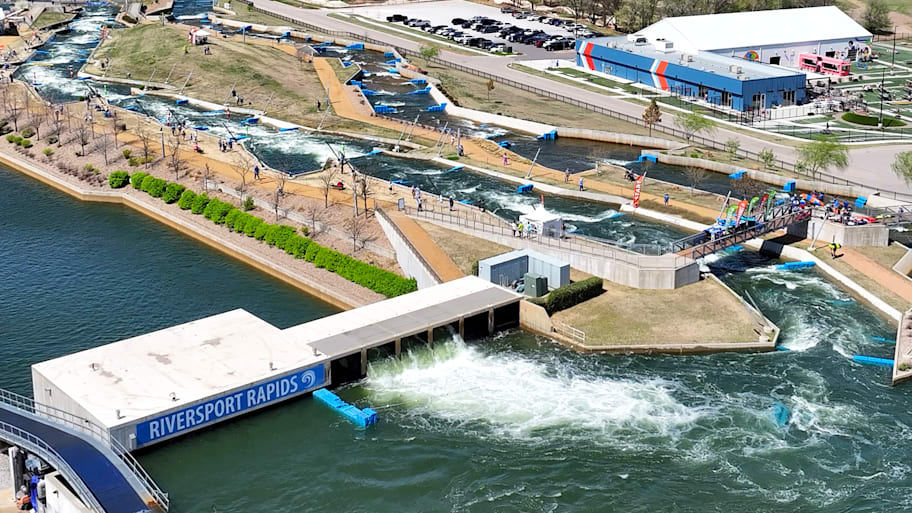
I dipped my paddle in the water and helped steer our raft toward the right-hand side of the channel. We reached the end of the man-made waterway and docked on a mat of interlocking rubber pieces in the center of a metal conveyor belt that began dragging us up toward the sky.
“It’s like the start of a roller coaster,” said David Holt, the mayor of Oklahoma City. He was seated to my left, legs folded into the front of the vessel, dark blue helmet tamping down his well-coiffed mayoral haircut. It occurred to me in that moment that he had provided perhaps the most obvious metaphor in the history of sports writing. An hour ago, we were standing in the finish line tower that overlooks the city’s internationally renowned flatwater rowing course. We had talked about the role of sports in the city’s recent ascent and how the Thunder’s NBA championship would elevate it even further.
We’d talked about the city’s crowning achievement, how OKC had—some readers may now be learning for the first time—managed to land seven medal events across two sports in the 2028 Los Angeles Olympics.
“We feel like it’s sort of a brand lifter and identity changer that will forever change the way we see ourselves and the way others see us,” the mayor said. And suddenly we were being lifted, 150 feet up the escalator. Once at the top, our raft hung a left and turned around a corner, back toward the Oklahoma City skyline to the west, Los Angeles 1,300 miles beyond that.
The news broke in June 2024 and it struck many sports fans to be about as random as the rapids suddenly laid out before us on the official 2028 Olympic whitewater canoe slalom course. But to hear it told by the sports-minded civic leaders of a city that Holt says has leveraged sports to enhance its identity as much as any other, the news fit the pattern of a transformation that had been underway for decades.
For the past seven years, this idea that Oklahoma could host a portion of the Los Angeles Olympics was limited to about 10 people. It was so top secret it had a code name: Project Thorpe, in honor of Jim Thorpe, native Oklahoman and gold medalist at the 1912 Olympics, a legendary multisport star whom the AP named the greatest athlete of the first half of the 20th century.
Holt, who spoke at the Thunder championship parade and shortly thereafter unveiled the renderings for the team’s shiny, new billion-dollar arena, has taken to calling 2025 “the greatest summer of our lives.” Perhaps, he acknowledges, until 2028.
The fan-in-chief
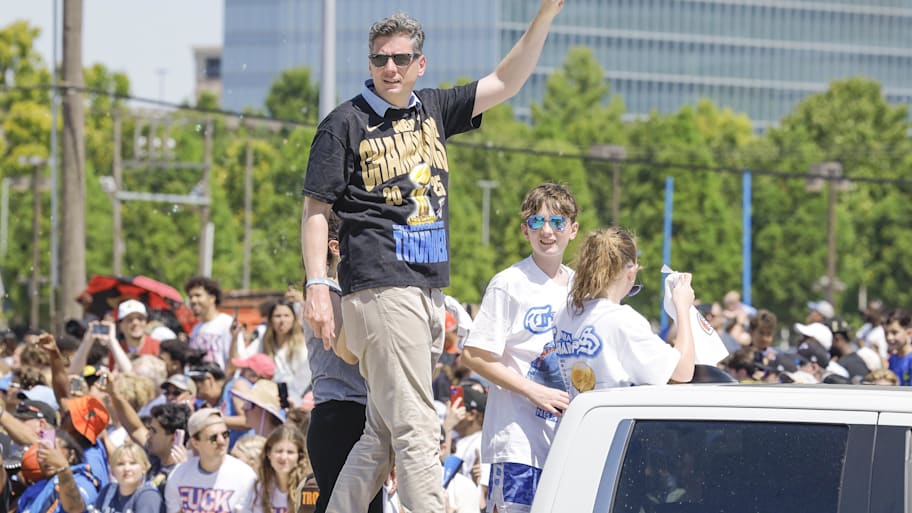
Holt is essentially OKC’s fan-in-chief. After the Thunder won Game 7 of the NBA Finals at the Paycom Center downtown, he moseyed onto the court and gave media interviews. At the parade, he tapped into his high school days, when as spirit vice president he oversaw pep rallies. He belted out the name of every player and key executive as he bestowed an official day, recognized by the city, on each of them.
“It reflects my own passion for sports,” Holt says of his presence amid the celebrations, “but it is also, I think, a reflection of how uniquely important this team is to the city. It’s our first team, our only team, and its fortunes very much feel like they track with our city’s.” The mayor is quick to point out he is not just a front-runner. His social media feeds have long offered running commentary on basketball matters, even through last-place seasons, interspersed with official city business and local restaurant recommendations.
Holt is the rare politician in 2025 who seems to have wide bipartisan approval. He won reelection to a second term in 2022 by a nearly 40-point margin. This summer alone, he wrote an op-ed in the New York Times, a local brewery named a beer after him and 405 Magazine wrote about his dog. In June, Holt was elected president of the U.S. Conference of Mayors.
He was born in Oklahoma City in 1979 and has watched his hometown transform, not just in population—from the country’s 37th-largest then to 20th now—but in reputation and stature. The city went through a devastating economic downturn in the ’80s and a key part of the recovery, as just about every local tells it, is MAPS (Metropolitan Area Projects), a series of taxes that have raised funds for a slew of transformative community initiatives. MAPS 4 was passed in 2019, as citizens kept doubling down on investing in the city. The original MAPS program in 1993 funded the arena that the New Orleans Hornets played in when they needed a temporary home after Hurricane Katrina, and later helped capture the Seattle SuperSonics.

“Professional sports franchises are the closest thing that Americans have to bestowing a blue ribbon on our top cities,” Holt says. “We entered a new tier when we got a team. We are a textbook case of how that first team can make so much difference.”
MAPS began reshaping the Oklahoma City sports landscape well before NBA franchises started calling. It begins with the water flowing outside the finish line tower.
“This was an ugly ditch,” Holt says, looking out at the Oklahoma River. The first MAPS program included funding for dams to refill the water supply from bank to bank. In the early ’90s, Holt says it would have been full of broken televisions and old tires.
“We were sick of mowing it twice a year and sick of looking at this hideous scar through our downtown,” he says. But few in town could have known the prosperity that would soon pop up along the river.
“It was aesthetic,” Holt says. “We were certainly not thinking about a rowing community.”
Someone was.
“It was dug out for rowing”
Mike Knopp is often alone in the finish line tower. The third floor is his, with floor-to-ceiling windows looking out in every direction. Credentials from races around the globe dangle on lanyards strewn atop whiteboards and trophy cases around his desk. A stripe across the carpeted floor travels along the extended path of the finish line on the course below.
Holt says the story of OKC snagging a piece of the Olympics stretches back seven years. Knopp’s origin story began well before then.
He moved a few times as a kid, including a stint in Maryland where he remembers watching the Naval Academy rowing team on the Severn River in Annapolis. As an undergrad at Oklahoma State, the former high school swimmer was surprised to see a flyer that said to join crew. Who knew they even had water in Oklahoma? He gave it a shot.
After beginning his legal career as an assistant DA in Oklahoma County, he set up a community rowing program on Lake Overholser. The first MAPS project was in the process of giving the city a major facelift, with the river soon to be filled.
“It was probably the least exciting project for people,” Knopp says. “We’re talking about an arena and a [minor league baseball] ballpark and a canal, and the river had such a bad reputation that people couldn’t envision what a real river would look like.”
But he saw the potential right away.
“I knew just because I was a rower. There’s a really straight ditch—it’s like totally straight—it’s 400 feet wide, if you looked from Google Earth down on it, it would look like it was dug out for rowing.”
Knopp began reaching out to community leaders, but also took matters into his own hands. He knew the groundbreaking for the first dam would attract media attention. Fortunately, it had rained the night before, just enough to leave some water in what was typically a dry ditch. Knopp and a few friends lugged a boat over the rocks and down into the river. The next day they were on the front page of the Daily Oklahoman, the biggest newspaper in the state.
Knopp connected with local business leaders and told anyone who would listen what an opportunity it was.
“I kept trying to emphasize the riverfront development through sports and not through the traditional means,” Knopp says. He notes that rivers in other cities are lined with restaurants and hotels because a city is already built up around them. This was a blank slate. “How many times do you have a chance to reinvent an entire landscape?”
A turning point came when Aubrey McClendon, CEO of the influential Chesapeake Energy Corporation, committed to be the lead sponsor of a multimillion-dollar boathouse. More boathouses would follow.
Knopp decided to host Oklahoma City’s first real race on the river in 2002. It included rowing teams from OU and Oklahoma City University, where he’d started a program and begun coaching. “This is no disrespect to the teams,” Knopp says now, “I mean, we thought it was a huge deal just to have people from Wichita come.”
He saw a fork in the road. “We cut the ribbon, and I said, O.K., we could go one of two ways. We could either build this small or we could recognize that we have a shot with this venue to be truly world-class.” He chose the latter.
He planned a much bigger regatta, the OCU Head of the Oklahoma. This one had more fanfare—jumbotrons and a petting zoo—as he tried to introduce the community to a new sport. He invited Harvard’s rowing team and legendary coach Harry Parker agreed to come during their first phone call. “He got it. He saw what I was trying to do and was like, Look, I know we need to grow rowing in the heartland, so we’ll go ahead and come.”
Knopp deployed a sort of fake-it-till-you-make-it strategy to reach new milestones. He knew OKC would never land one of the established international events, so in 2007 he made one up and called it the USA Rowing World Challenge. “Totally out of thin air,” he jokes. “We had a press conference. The World Challenge is coming!”
He went to the actual world championships in Munich, without any credentials, and snuck his way into back areas where he could recruit. He came away with one commitment: the Republic of Georgia. He returned to the States and convinced Canada to send a team. The Czech Republic said they’d come under one condition: Knopp had to promise their athletes could ride Harleys on Route 66. Suddenly, Australia and New Zealand were in. The Aussie coach said on camera that it was an amazing venue, which was all Knopp needed. By 2008, Oklahoma City was the site for Team USA’s official Olympic trials for canoe sprint.
Knopp kept pushing boundaries as he tried to make his sport go mainstream, looking to PGA Tour events and NASCAR races for inspiration. They put up stadium lights and raced at night. “People loved it,” Knopp says. “It became the thing we were known for.”
By the time voters were ready to say yea or nay on MAPS 3, Knopp had two big ideas he wanted to get on the ballot: permanent lights and a whitewater course. He went to a pitch meeting that was like an episode of Shark Tank.
“My big narrative was, every great city has stadiums and ballparks—and we have those and that’s great—but we could do what nobody else has, really lean into this water sport thing and make it a differentiator.”
They bought his pitch. So when the city passed MAPS 3—which included projects ranging from a new downtown convention center to expanded walking and biking trails to a streetcar transit system—it had itself plans to build a state-of-the-art whitewater facility.

The softball capital of the world
The Olympic rings are already printed on the sign welcoming cars into the parking lot at Devon Park. The IOC is particular about who gets to use its insignias, but as the official home of the national governing body that selects Team USA’s rosters, the most famous softball complex in the world has long fit the bill.
“We’re the only group that can send [a softball team] internationally with USA across your chest,” says USA Softball CFO Cheryl Bond, who wears many hats for the organization. That includes men’s and women’s, slow pitch and fast pitch at multiple age levels.
Devon Park is most famously the home of the Women’s College World Series, when temporary bleachers raise the seating capacity of the main stadium field to 13,000. But the facility hosts more than 1,000 games a year, which requires use of four fields practically round the clock. “Everybody sees 15 of them [on TV] and they think that’s what we are,” Bond says.
This facility happens to have a tie-in to the Olympic movement—and to Los Angeles. When L.A. hosted the 1984 Olympics, the city’s Olympic Organizing Committee was left with a surplus of funds to invest around the country. USA Softball was interested in building on its presence in OKC and those investments led directly to this stadium that will now host Olympic softball when most of the Games return to Southern California.
“We began calling ourselves the softball capital of the world,” Holt says of a slogan now stamped in all caps along the outfield wall. “I don’t know that anybody was arguing or competing for that with us,” he laughs. “We were looking for things to call ours.”
The city landed the Women’s College World Series in 1990 and grew into the moniker. Stadium renovations, including a permanent upper deck before the 2021 WCWS, led to an agreement with the NCAA that ties the event to OKC through at least 2035.
Bond didn’t know Oklahoma City was hoping to host Olympic softball until shortly before it was proposed to be voted on by the IOC.
“I’d planned to retire at the end of ’26,” she says. “My honest first reaction was, I guess I’m working two more years. It’s truly a once-in-a-lifetime opportunity.”
Luring the Olympics
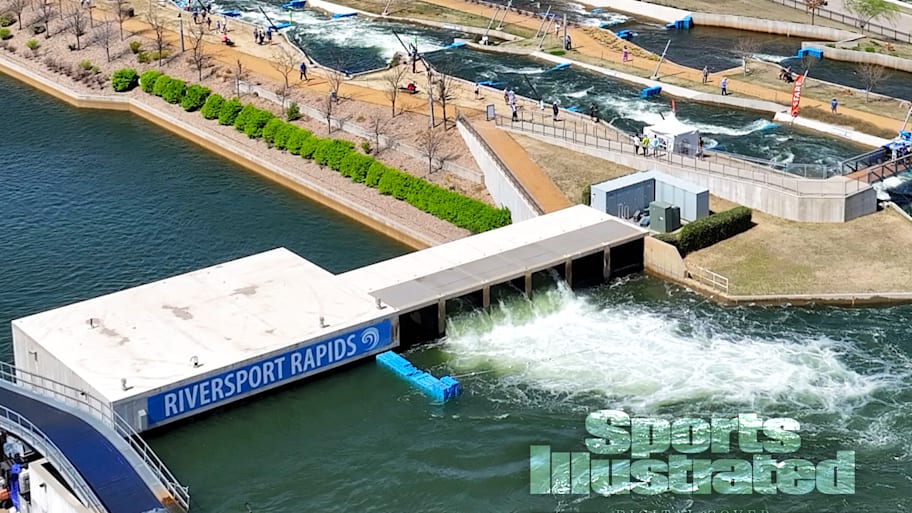
Knopp swears he was joking. Mostly. Officials from LA28 were in town to take a tour of his Riversport facility. This was after he had left his law career behind and fully dived into the role of executive director. After he had parlayed the success of Oklahoma City’s flatwater course into the construction of a whitewater facility that pumps nearly 500,000 gallons of water per minute through two channels that are 1,300 and 1,600 feet long. It has become a vast sports complex, where visitors have access to a high ropes course, a zipline and a man-made surfing wave that hosts professional competitions. Police and fire departments come in from other states to use the facility for emergency water rescue training.
It was obvious what an undertaking it is to build a facility like Riversport.
“We could just make it real easy on you and have it here,” Knopp joked.
His timing coincided with a larger Olympic-wide effort to consider sustainability. After years of Olympic venues being constructed at great cost and then decaying in disuse soon after, cities and governing bodies were thinking about how to host the Games in a more environmentally and financially responsible way.
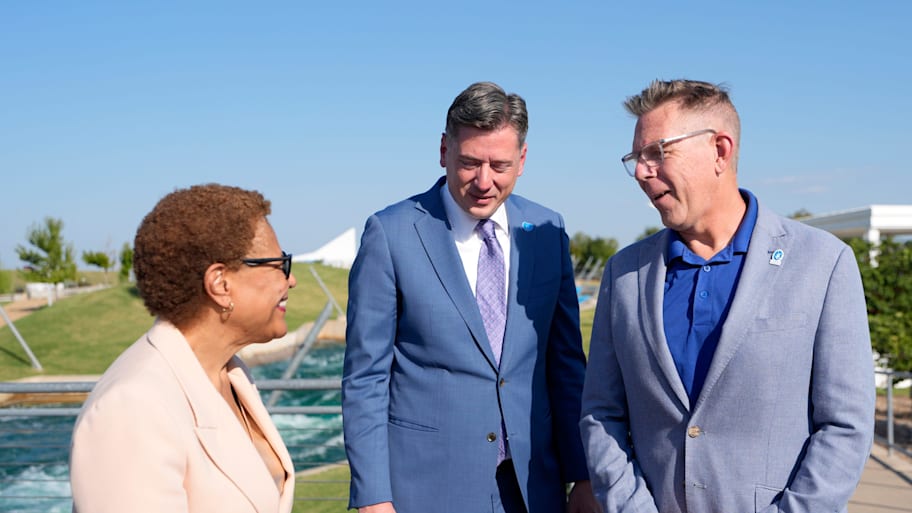
Holt’s side of the story begins with a dinner. He had become friends with then Los Angeles mayor Eric Garcetti, who was in town one night after Holt took office in 2018. Garcetti broached the idea of bringing the canoe slalom events (which includes races in canoes and kayaks) to Oklahoma and Holt says he knew instantly that he’d do whatever it took to make this a reality.
“For a kid from Oklahoma City, who was already in awe of the fact that we had an NBA team, the idea of hosting Summer Olympic events, having medals put around the necks of athletes in Oklahoma City, like for real, not an Olympic trial, was beyond my wildest imagination,” Holt says.
He and Knopp drafted a letter touting Oklahoma City’s rich athletic history and connections to Los Angeles. Everything from Route 66 connecting the cities; to OKC housing the Dodgers’ triple-A affiliate; to Will Rogers, nicknamed “Oklahoma’s Favorite Son” and the namesake of OKC’s airport, also being a star in Hollywood. (You can read the full letter, shared publicly for the first time, here.)
As the small circle of Project Thorpe worked behind the scenes, more benefits emerged. When they began pushing to host canoe slalom, softball wasn’t even part of the 2028 Olympic program. Baseball and softball, a combined entity for Olympic purposes, were excluded from the 2012 and ’16 Games. As the Olympics evolved to give host countries added flexibility to choose a few sports each cycle, Tokyo brought baseball and softball back in 2020. Paris 2024 left them out.
One person working to get baseball and softball back in the Olympic program was Craig Cress, the executive director of USA Softball. Cress got his start with USA Softball as an umpire living in Indiana in the late 1970s. He moved to OKC in 2002 to become the organization’s membership director, before ascending to the top position in 2013.
Since 2017, he has also served on the executive board for the World Baseball Softball Confederation, where he was lobbying for inclusion in the Olympics. “I knew we had a good chance in the U.S. because we are a bat and ball country,” he says.
At the pitch meeting, Cress was in charge of discussing the softball facilities. Baseball was a no-brainer. The Olympics will make use of Dodger Stadium, with MLB potentially pausing its season so players can compete. Cress focused on minor league baseball parks and college softball fields.
“I never brought up Oklahoma City,” he says. “It wasn’t my job at that time to talk about Oklahoma City.” The limitations of Southern California quickly became clear, though. Most college softball fields are 220 feet in center, but 190 down the foul lines. WBSC dimensions are 220 feet all the way around.
Cress was in Miami for the 2023 World Baseball Classic when WBSC president Riccardo Fraccari and LA28 vice president of sports Niccolo Campriani met him at his hotel. “Riccardo asked me, ‘Where’s the best softball facility at?’” Cress remembers. “And I said, ‘This is not going to sound real unbiased, but the best softball facility in the world is in Oklahoma City. What our city has built and what USA Softball maintains.’ And Nico kind of looked at me and goes, ‘Would you guys consider hosting the softball portion of the Olympics for us?’ And I said, ‘Absolutely we would.’”
Cress soon learned that Mayor Holt was already working on bringing the Olympics to Oklahoma. As it so happened, the softball stadium with the greatest seating capacity in the world—along with the facilities to handle an entire tournament in one complex—happened to be in the same city that for years had been vying to lure canoe slalom events out of L.A.
In October 2023, LA28 announced that its version of the Games would include the return of baseball and softball. The IOC also approved lacrosse and cricket for the first time in over a century, and the Olympic debuts of flag football and squash.
Meanwhile, Knopp’s Riversport facility was further burnishing its reputation. After Russia invaded Ukraine in early 2022, the International Canoe Federation moved two events that had previously been awarded to Russia. Oklahoma City stepped in to host both on short notice.
As Knopp had built up the infrastructure that turned a city whose river didn’t even have flowing water until about three decades ago into a haven for international paddlesports competition, he kept leaning on one phrase: Olympic standard. It was something he abided by for every project, dating back to that very first boathouse.
“I used to say, Let’s build it to an Olympic standard,” he says. “Not because we think we’re gonna host the Olympics, but because it doesn’t get any better than that.”
The world is now seeing the result of that diligence.
Making OKC feel Olympic
Michael Byrnes was Employee No. 1 of the newly formed Team OKC. His job is to make sure the city is ready when Day 0 arrives.
Byrnes spent 23 years in professional baseball, including the past 15 with the minor league club in OKC. As the team’s president and general manager, he embedded himself in Oklahoma City’s sports scene. He was out of town when the Olympics news dropped in 2024, and was just as surprised as anyone. He raised his hand for the job immediately.
Three years out, he’s already thinking about vehicular traffic and pedestrian walkways, building temporary stands, engaging the city’s arts community and selling more than 200,000 tickets.
Everyone involved with OKC’s Olympic efforts is touting the benefits. That includes extending NBC’s daily broadcast window with competition two time zones east of the Pacific Coast.
Plus, sequestering athletes in certain sports far from their fellow Olympians is not new. The Paris Olympics staged surfing on the other side of the world in Tahiti. But for the athletes in OKC, it will mean missing out on some of the aspects that make the Olympics the Olympics.
“It’s something we’re acutely aware of,” Byrnes says. “We want to make sure that we deliver a fantastic experience for the athletes and all of those associated with the travel party.”
It’s still early in the planning process, but Byrnes says they’ve begun conversations about getting athletes transportation between OKC and L.A. Softball won’t begin play until Day 9, which helps. “If we can leverage an opportunity to get them to Los Angeles so that they’re part of the opening ceremonies and can be at the athlete village for some period of time, we’re motivated to do that,” he says.
“I can tell you right now, Team USA will be there,” Cress says. “That’s the one team I can speak for right now. We’ll be there for opening ceremonies.”
Canoe slalom will begin the morning of the opening ceremony, but finish when softball starts. For some of those athletes, Oklahoma City will feel like a home game.
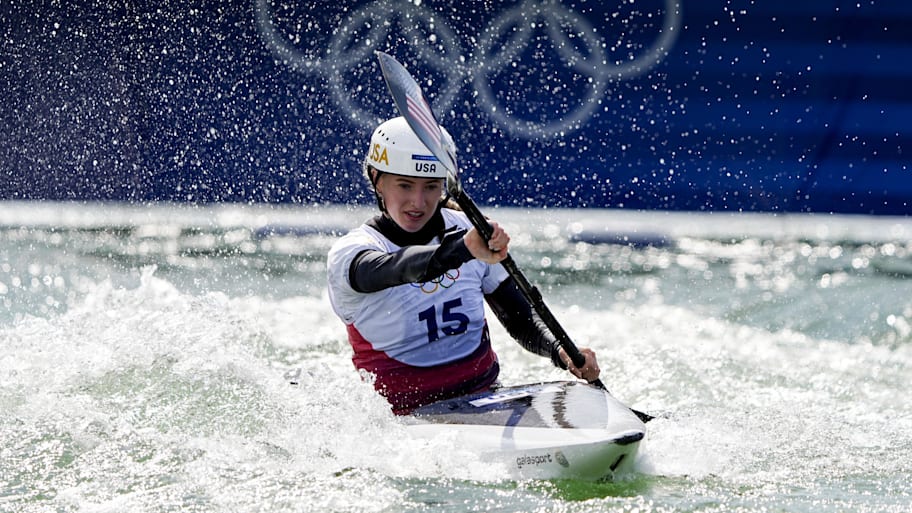
Evy Leibfarth, who won a bronze in women’s canoe single in Paris, has been coming to Riversport since she was 13. She’s attended two-week national team training camps over Thanksgiving, along with annual races and the Olympic trials.
“Honestly, I wasn’t very surprised,” she says of the news that Oklahoma City would host her sport’s Olympic program in 2028. “I think that Oklahoma seems like it’s an Olympic course. … When I heard the news, I was just like, That makes a lot of sense. That’ll be cool.”
Leibfarth had previously competed in the Tokyo Olympics, which were postponed to 2021 and held with no fans and an athlete village under COVID-19 protocols.
“[In 2024], it just felt like there was so much going on, and so much energy and excitement around racing, which was really cool. I’ve never raced in front of that many people.”
In Paris, Leibfarth was Team USA’s only woman in her sport, so she was paired with randomly assigned roommates—weightlifter Olivia Reeves and U.S. water polo players. After Leibfarth finished competing, she got to watch Reeves win a gold medal. She admits that the experience would feel a little different in an environment where something like that can’t happen.
“For sure,” she says, though she also caveated that first she is hopeful to qualify again. “There’s definitely a part of me that’s quite sad about that. I think that one of the most special parts of the whole Olympic experience is being in the village and being surrounded by people who you know are feeling exactly the same way that you’re feeling—you know, anxious, excited, happy, sad.”
Cress says if he could change one thing about the process, it would have been to get even just 12 hours to tell the athletes before the announcement was made publicly. He says once people got over the initial shock, the plan made a lot of sense.
He also points out that Team USA’s softball players didn’t experience the opening ceremony in Tokyo because it was a travel day between games, which began two days prior. He also says even if the softball games were in California, it’s no guarantee they would have stayed at the athlete village, with up to 80-mile distances between possible venues.
“Our athletes are all worried about, Well, it’ll be like the World Series, and I start laughing. I’ve been around L.A. 2028 enough already to know that the branding will be on steroids compared to what they do at the NCAA, and a lot of the other things that we do for the Olympics will be a lot higher level than what we’re doing for the NCAA.”
He says the stadium is already looking into renovations that could include moving the outfield scoreboard to accommodate higher seating and replacing the stadium’s original chairbacks installed in the ’80s. They are also constructing an indoor practice facility that’ll put two full-sized infields, hitting nets, equipment rooms and more amenities underground, connected to the stadium.
“The great thing for us is that the NCAA and USA Softball and the city of Oklahoma City will have this facility for years to come, and we’ll be able to continue to maximize what we do for the sport of softball and continue the legacy,” Cress says.
Riversport will similarly be Olympified, from signage to seating.
“I know Team USA is going to do a really good job of making us feel at home in Oklahoma,” Leibfarth says.
“It’s immortality”
In 1989, Oklahoma City hosted the U.S. Olympic Festival, an event that was discontinued after 1995 but once brought Olympic sports to non-Olympic cities in off-cycle years. Track and field star Florence Griffith Joyner, who’d won three golds and a silver the year before in Seoul, carried the Olympic torch into OU’s football stadium in Norman, at a ceremony where Bob Hope emceed and Ronald Reagan spoke.
“Most people have no idea what I’m talking about,” Holt says. “Everybody here remembers OK89.” The OK89 logo was painted on a prominent water tower in town for 20 years, he notes. “It was a big deal to us.”
This will be different.
“It’s immortality,” the mayor says. “We will talk about having done this for a half century. You go to cities that have had Olympics and they have Olympic Boulevard, they have monuments. I mean it’s forever, like it changes your city.”
It will be the capstone project for a city that has already been transformed by sports.
“America in 2025 is still obsessed with sports,” the mayor says. “Whether it’s professional sports, high-level collegiate sports or the Olympics. And it is undeniable that we have leveraged sports—the Thunder, the Olympics, the Women’s College World Series, other kind of one-off things—when you look at all of that in its totality, you start to say, Wow, Oklahoma City, whether they meant to or not, has collectively really leveraged sports to take themselves to another level.”
The city is still building—and not just the new Thunder arena.
“Growing up here, all of my friends and all of my colleagues, as soon as you got a diploma from a university here or from high school, you said, I’m moving to Dallas. I’m moving to New York. I’m moving to Los Angeles,” says Christian Kanady, CEO of Echo, a company that purchased 60 acres of undeveloped land downtown to build a multipurpose stadium, with soccer as its primary function. None other than Russell Westbrook has signed on as an investment partner.
“And so not only arresting some of that brain drain, but now having the boomerang effect of people wanting to come back home and raise their family here, it’s beyond exciting.”
For a generation, OKC was known for tragedy. The 1995 bombing of the Alfred P. Murrah Federal Building was the deadliest terrorist attack in the country until Sept. 11, 2001. As the Thunder championship parade wound down NW 5th Street downtown, team photographer Jimmy Do captured a striking image of the team bus, players’ arms outstretched in joy with the memorial in the background. The instantly iconic photo, juxtaposing the city’s worst day with what many now consider its best, now hangs within the memorial’s museum with the caption HOPE WINS.
Holt says it was like rewriting the ending to that story, though this moment in OKC hardly feels like the ending of anything. If anything, it may be the start of a prolonged run at the pinnacle of the world’s athletic stage. The Thunder began their title defense with 24 wins in their first 25 games, as fans dream of even more championship banners hanging by the time they build rafters in the new arena.
Knopp played NBC’s Olympic theme music at that inaugural World Challenge, just to make his event feel prestigious. To make people think this location was deserving of that stature. In less than 1,000 days, the Olympics will come for real. That same music will swell and its presence will be wholly appropriate.
It seems almost unbelievable. Whitewater rapids where there was once a ditch to mow. And on the other side of town, a softball facility bearing a slogan that will soon take on new meaning.
The news caught many off guard in 2024 and will likely catch another wave of them when Day 0 arrives. Why, when the Olympics come to Los Angeles—a metropolis teeming with stadiums and arenas, full of athletic history and currently celebrating its own major championship—will two sports be exported halfway across the country?
But the trajectory of Oklahoma City, its use of sports to transform its identity and its recent uptick in prominence within that world means that with each passing year, it may just feel like less of a surprise.
More Olympics From Sports Illustrated
- The Inside Story of How Oklahoma City Landed Seven Events at the 2028 Los Angeles Olympics
- Read the Letter Oklahoma City’s Mayor Sent Los Angeles’s Mayor About Hosting Olympic Events
- Projecting Canada’s 2026 Olympics Ice Hockey Roster
- Projecting Team USA’s 2026 Olympics Ice Hockey Roster
- NHL Executive Addresses League's Approach to Smaller Olympic Rink Sizes
This article was originally published on www.si.com as The Inside Story of How Oklahoma City Landed Seven Events at the 2028 Los Angeles Olympics.