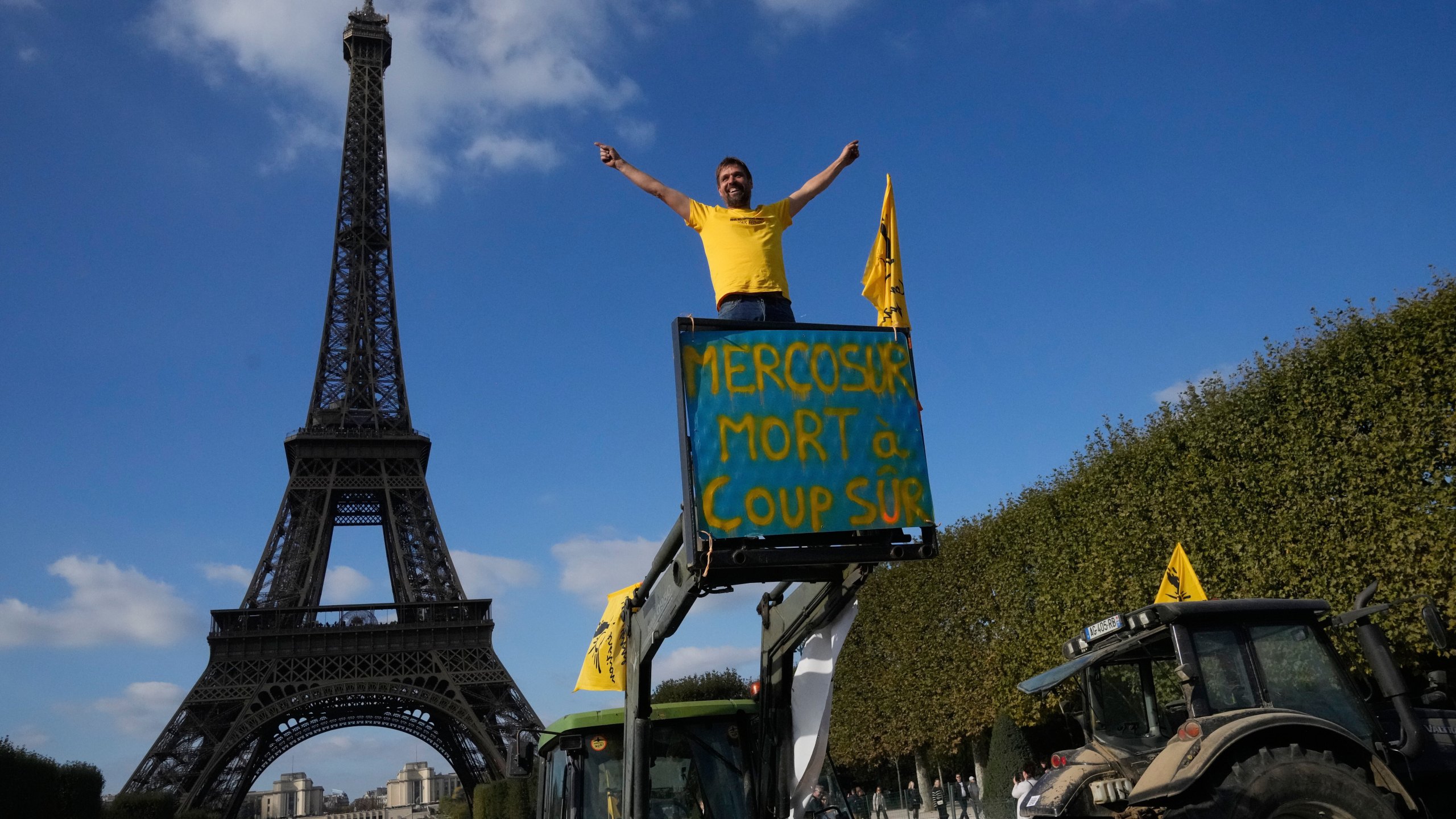
BRUSSELS (AP) — France is throwing up a last-minute obstacle to a massive trans-Atlantic trade deal between the 27-country European Union and the five South American nations of the Mercosur bloc that’s taken a quarter-century to negotiate.
Angry European farmers fearing new competition from the EU-Mercosur pact are marching on Brussels, and European negotiators who thought they would finally wrap up the deal this year are facing a tough week.
The deal between the EU and the five Mercosur countries — Brazil, Argentina, Uruguay, Paraguay and Bolivia — would progressively remove duties on almost all goods traded between the two blocs over the next 15 years. Provided it is ratified by both blocs, the accord would cover a market of 780 million people and a quarter of the globe’s gross domestic product.
Negotiators agreed on the EU-Mercosur deal a year ago, but it now must be approved by all 27 EU countries, as well as the European Parliament.
Both the European Commission President Ursula von der Leyen and European Council President António Costa are scheduled to sign the deal in Brazil on Dec. 20 — if aggrieved farmers marching on Brussels and vocal opposition from key EU nations don’t derail their plans.
The deal faces headwind
In the run-up to what many expected to be the final stretch, French Prime Minister Sébastien Lecornu said on Sunday that the current EU-Mercosur deal was “unacceptable,” and that conditions for a vote of EU heads of state and government on Thursday “have not been met.” He requested a delay, which would push the vote to 2026 or beyond.
While commending recent measures taken by the European Commission to both protect farmers and increase inspections of agricultural imports for food safety violations like pesticides banned in the EU, Lecornu said that France has not been fully placated.
“It is clear in this context that the conditions are not in place for any vote by the EU Council on authorizing the signing of the agreement,” he said.
Poland, Austria, the Netherlands and France are concerned that Mercosur exporters could undercut EU products made with stronger labor and sanitary regulations like pesticide restrictions, said Alicia Gracia-Herrero, a senior fellow at the Brussels-based Bruegel Institute. France has failed to get Mercosur to agree to “mirror” those regulations.
She said that the deal reflects limits on the EU’s geopolitical strength, political unity and capability.
“If we cannot get this done even with (U.S. President Donald) Trump’s pressure, what can you expect from the EU?” she said. “I hope France cannot fully torpedo this because the EU cannot afford a further delay in Mercosur if it wants to be credible with other ongoing trade deals, such as Indonesia and, even more so, India.”
Another kind of trans-Atlantic pact
In the wake of Trump’s tariff blitzkrieg earlier this year, when Washington imposed levies of 15% on most imports from the EU, the bloc has sought bilateral trade deals to help weather with aggressive trade tactics from both the U.S. and China, its historical top trading partners.
European Commission spokesperson Olof Gill said that Brussels would push to have the Mercosur deal signed by the end of the year because it puts the EU’s geopolitical credibility on the line.
“We’re talking about bringing together two of the world’s biggest trading blocs. And in so doing, in a time of rising geopolitical uncertainty, we create a platform based on trust, based on rules, where we can work with Mercosur on the big challenges at global level of our time. We’re talking climate, economic security, reform of the global rules-based order, and so on,” he said.
From Spanish ham and Italian wine to Dutch dairy and Greek olives, agriculture is central to the European Union’s budget, economy, culture and politics. The EU exported 235.4 billion euros ($272 billion) worth of agricultural goods in 2024.
Many farmers loathe the Mercosur deal, but its proponents in Brussels say it would save businesses some $4.26 billion in duties each year, streamline sales, and remove tariffs on products like French wine, Argentinian soybeans, Brazilian rare earth minerals, and German pharmaceuticals.
Its critics in France, the Netherlands and other countries with big dairy and beef industries say the pact would subject local farmers to unfair competition and cause environmental damage.
Necessary or adequate adjustments
Such opposition has prompted Brussels to propose new protections for the EU’s agricultural sector.
Last year, the European Commission vowed to slash red tape for farmers and more equitably distribute annual agricultural subsidies of 50 billion euros ($58 billion) across bloc.
In October, the commission set up new mechanisms allowing farmers to trigger investigations if the prices of imports from Mercosur are at least 10% lower than the prices of the same or competing EU products. Serious violators could get their preferential tariffs temporarily withdrawn.
In December, the commission proposed to ratchet up border inspections to check if imported agricultural goods were produced with pesticides banned in the EU.
But those moves have not soothed French fears nor the anxieties of farmers.
Agricultural unions are once again planning demonstrations in Brussels as leaders and diplomats meet for the European Council on Thursday.
Disgruntled farmers used tractors to paralyze many European capitals as part of a campaign lionized by the far right in the run-up to their successful showing in EU-wide elections in 2024. ——— Associated Press writer Sylvie Corbet contributed from Paris.